

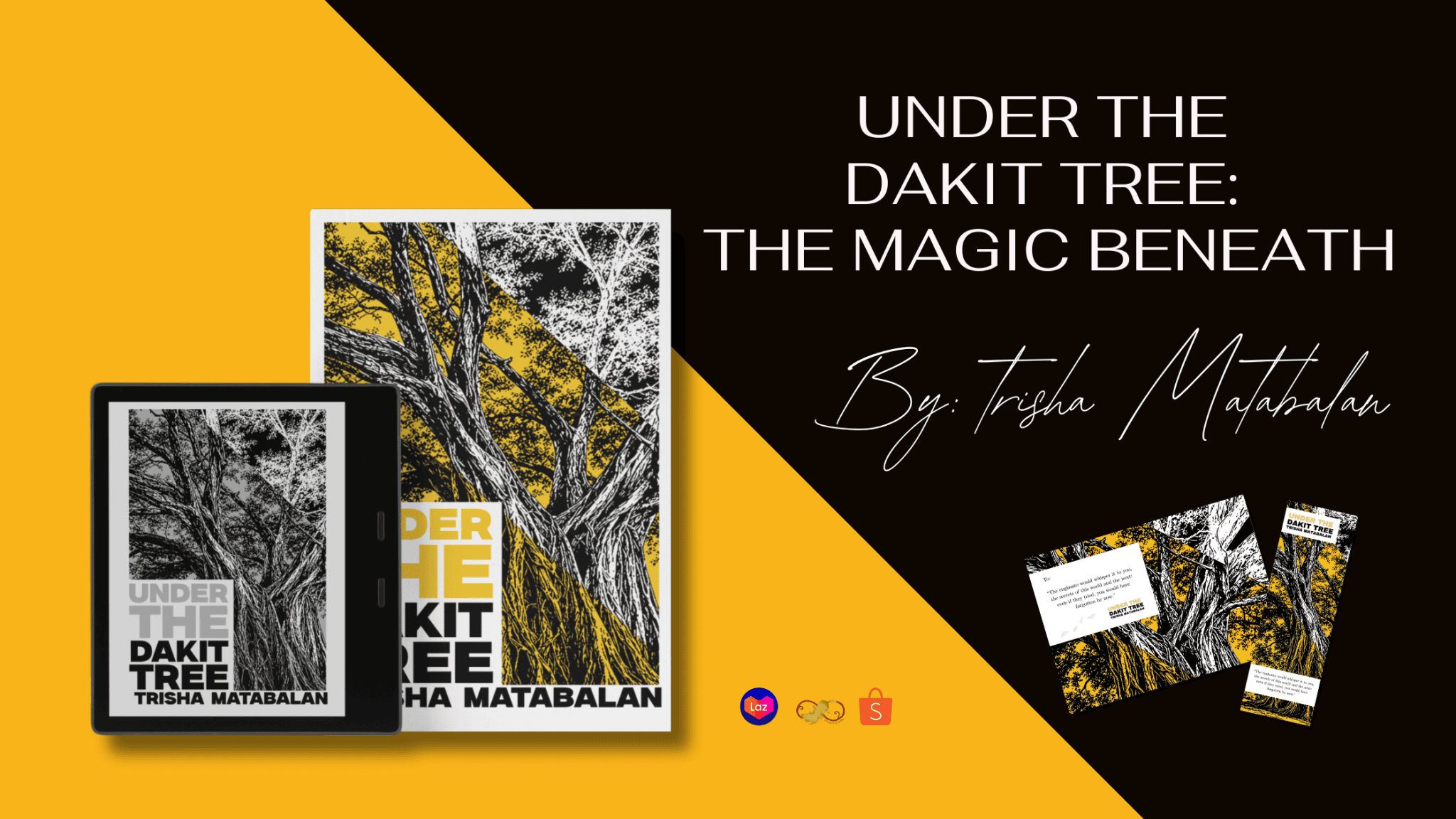
The magic beneath the dakit tree: a conversation with Trisha Matabalan
Beneath the Dakit Tree, the real and the imagined refuse to be separated.
Trisha Matabalan’s Under The Dakit Tree is a compilation of stories rooted in Bohol’s folklore, shaped by her childhood, and woven with quiet magic, where spirits like neighbors and myths feel like home. Let Trisha show you a place where a supernatural isn’t scary; it’s just part of life.
Significance of the Dakit Tree itself as the central symbol and title.
The dakit tree or the balete tree has always been the center of many ghost stories in the Philippines. If you hear about one, it’s usually paired with the appearance of a white lady or a kapre. For me, since my house was built right next to one, I always heard a number of them growing up. In fact, my father recently revealed an entirely new story to me, one that I didn’t know while I was in the process of writing this collection. I thought it would be an interesting concept to center a barangay around a tree like that.
The real and the imagined cannot or refuse to be distinguished.
Most superstitious beliefs usually mythologized itself throughout the years, especially when it’s spread down from generation to generation, but they definitely began as warnings. I put a lot into researching magical realism for this collection of short stories. This collection is actually my undergraduate thesis, so it was actually required for me to put my back into it. I don’t regret it, of course, and it definitely helped me build a clearer picture.
I think I built it with a lot of attention to how magical realism as a genre worked, and how it felt like as a child hearing those stories, wondering if it was really true or not.
A tight-knit small community exploring myths and supernatural beliefs.
I think it has more to do with how oral literature usually propagates through small communities. Besides, community is a very important part of Filipino culture in general, and since a barangay is the smallest government unit in the Philippines, I thought it’d be prudent to start with that.
Knowledge or memories of Visayan/Boholano culture, traditions, and superstitions shaping the stories.
It helped a lot! As a child, I kept hearing about these stories. I just never forgot them. They were that impactful. A part of why I could never let go was probably because a lot of those stories stayed rooted in how I lived and how I grew up. In the end, staying fascinated was the most important thing, as it got me here in the first place.
Crafting distinct personalities and voices while keeping the strong sense of one connected community.
I thought of how in small communities everyone had no choice but to know each other. That was the primary motivator for all the characters: maybe they didn’t like each other, but they would have no choice but to get to know each other. That made crafting the personalities easier, as I didn’t have to think about them getting along. I just had to consider the most interesting ways they could develop as a character and how they could potentially impact everyone else with their actions. Basically, I thought more of how a character’s motivations could cause its own insular butterfly effect more than anything else.
Aiming to frame the supernatural not as scary, but as something ordinary and lived-in for the people of Dakitan.
Yes! I wanted it to be something that felt like how I grew up with it—something I just accepted as real without question. Like, yeah, a kapre lives in the tree by the kindergarten. Sure. What’s next? I wanted it to feel like that.
Who connect most deeply with Under The Dakit Tree?
I think a lot of people will be able to connect with it, especially people who grew up with the same stories. But I don’t think they’re the only people interested in it. I think it could connect even more deeply with people who want to know the stories.
One story in the collection that closest to your heart, or one you hope readers remember longest.
While the first story that I wrote was actually Playing House, I especially love Dalaketnon’s Kiss. I spent so much time with all of the stories that I originally found it hard to reread, but I didn’t have that problem with Dalaketnon’s Kiss.
One sentence to describe Under The Dakit Tree.
A reimagining of the most mythic parts of Bohol’s folk literature.
UNDER THE DAKIT TREE | TRISHA MATABALAN