
THE LEGEND OF NOLA NIGHT STAR: A GLIMPSE
Some legends aren’t just told, they shine.
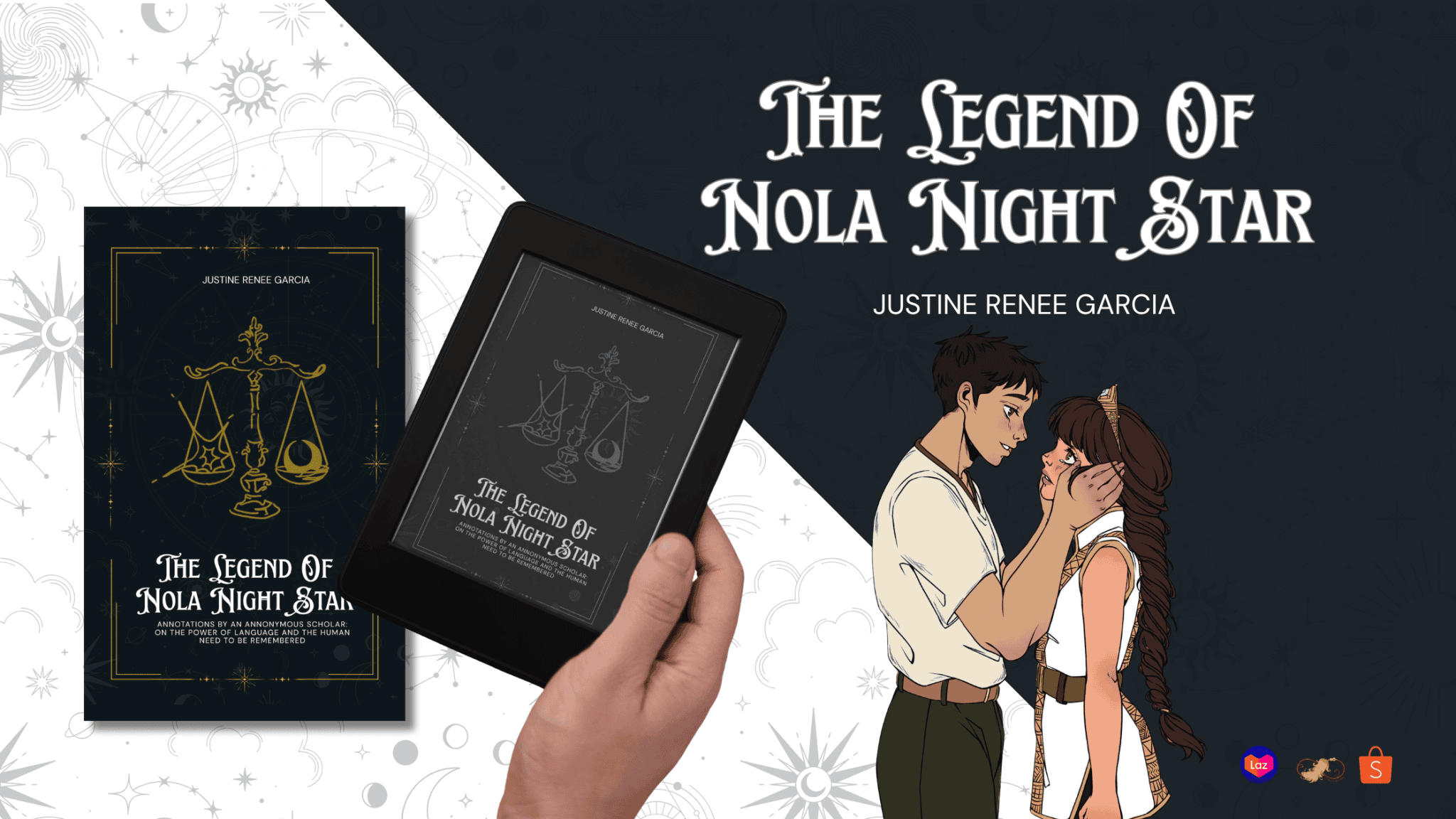
The Legend of Nola Night Star by Justine Renee Garcia is more than just a tale of magic or destiny. It is a story written in light and legacy, about the chosen girl. When the truth begins to twist and old secrets rise, Nola must decide: will she follow that path laid out for her…or forge her own among the stars?
Let the author give you a glimpse of the story.
How language command the elements, and what are the Root Tongues?
The magic system is probably one of my favourite things about The Legend of Nola Night Star because it started with a question I’ve been obsessed with for a long time, “what if language just didn’t describe the world, but could actually change it?”
In the novel, alchemy is activated through language. There are four Root Tongues, each connected to an element—Diwa for air, Daga for earth, Landos for water, and Dilaab for fire. To command an element, you have to speak its language. But it’s not really a magic-word situation where you memorize the correct vocabulary, and suddenly you can throw fireballs at people. Language carries history, culture, intention, and identity, so actually understanding a Root Tongue matters just as much as being able to speak it.
A lot of this came from growing up in the Philippines and being fascinated by how many languages we have, but also by the complicated relationship we sometimes have with them. There are languages we inherit, languages we lose, languages we’re embarrassed we don’t know well enough, and languages that become tied to questions of belonging.
So I wanted to literalize that. In Nola’s world, language has power because language is power. Who gets to speak? Whose language is considered important? Who gets access to knowledge? Who decides which languages survive?
The Root Tongues became my fantasy-world way of playing with all of those questions while also, of course, letting people yell at the wind and set things on fire. Which is the fun part.
What makes Nola so extraordinary to be the chosen one, and what weight does that title carry?
I think what makes Nola extraordinary is also the thing that makes her life incredibly difficult. She’s the Keeper of Alchemy, which means she can wield all four elements and speak all four Root Tongues. In her world, that makes her incredibly rare and incredibly powerful. So naturally, everyone looks at her and goes, “Great! You’re going to save us.”
Which is… a lot to put on one person.
I’ve always been interested in the Chosen One trope because we usually focus on the “chosen” part and not enough on the “one.” This is still one person being handed generations of expectations, problems, conflicts, and hopes, and then being told that because they have this extraordinary ability, they must somehow know what to do with it.
Nola doesn’t.
She’s powerful, but she’s also young. She makes mistakes. She gets angry. She questions the institutions around her. And throughout the story, different people have very different ideas about what the Keeper of Alchemy is supposed to be. To some, she’s a savior. To others, she’s a weapon. To others, she’s a threat.
So, I think the real weight of being the Chosen One is Nola eventually having to ask: chosen by whom? And chosen for what?
Her journey isn’t really about becoming worthy of the title. It’s about realizing that being extraordinary doesn’t mean she owes the world the version of herself it expects her to become. And eventually, she has to decide for herself what being the Keeper actually means, even if her answer is completely different from the one everyone wanted.
What was it like writing Nola’s journey from being raised to inherit a legacy to questioning everything she was taught?
I think writing Nola’s journey was interesting because I never wanted her story to be as simple as, “Everything I was taught was wrong, so now I’m going to reject all of it.”
Because growing up is rarely that clean.
Nola was raised knowing exactly who she was supposed to become. She has a title, a legacy, a family, and an entire institution telling her what the world looks like and what her place in it should be. There’s something comforting about that certainty, even when that certainty eventually becomes restrictive.
So when she starts questioning the School of Light, she also has to question herself. And I think that was the part of her journey I connected with the most. What happens when you realize that the people who taught you were genuinely trying to protect you, but they were also wrong about certain things? What do you keep? What do you unlearn? And how do you criticize something that you still, in some complicated way, love?
I didn’t want Nola to become cynical. I wanted her to become discerning.
By the end, she isn’t questioning everything because she suddenly believes in nothing. She questions everything because she finally understands that inheriting something doesn’t mean preserving it exactly as it was given to you.
Sometimes loving a legacy means being brave enough to change it.
The story touches on destiny, memory, and legacy. How do these three themes weave together?
I think destiny, memory, and legacy are constantly talking to each other in the book.
Destiny is what people tell Nola she’s supposed to become. Legacy is everything that existed before she arrived. And memory is this strange thing sitting between them, because so much of what we inherit depends on what people choose to remember, what gets forgotten, and who gets to tell the story afterward.
And I think that’s also how I ended up writing The Legend of Nola Night Star in the first place.
I’ve always been fascinated by language, especially growing up in the Philippines where there are so many languages existing beside each other, sometimes beautifully and sometimes very complicatedly. I grew up thinking a lot about what it means to belong to a culture when you don’t necessarily speak all the languages you feel you’re supposed to know. That eventually became this fantasy question: what if language literally held power? What happens when losing a language also means losing a kind of magic?
From there, Nola appeared.
And strangely, I think the story became more personal the longer I wrote it. Nola begins the book surrounded by people telling her that she is extraordinary and that she has this enormous destiny ahead of her. But eventually she has to figure out which parts of that future actually belong to her.
Maybe that’s where all three themes meet for me. We inherit stories about who we were, who our families were, who our people were, and who we’re supposed to become. But inheritance isn’t destiny.
We still get to decide what we carry forward.
And sometimes we get to decide what ends with us.
What do you want readers to take away from Nola’s journey?
I think more than anything, I want people to come away from Nola’s journey understanding that the world isn’t as black and white as we sometimes want it to be.
It’s very easy to divide the world into good people and bad people, heroes and villains, right and wrong. And honestly, it would be so much easier if life actually worked that way. But there are always grey areas. There are people and experiences we don’t understand, and I don’t think our first instinct should always be to fear or reject them.
Sometimes we just need to be kind-hearted enough to learn.
That’s a huge part of Nola’s journey. She was raised within a system that gave her a very specific understanding of how the world works, and she was eventually supposed to inherit and uphold that system. Questioning it means accepting that some of the things she believed were incomplete, or that there are perspectives she was never taught to consider.
And I think there’s something really important about being able to say, “I don’t understand this yet, but I’m willing to listen.”
Nola doesn’t end the story knowing everything. I don’t think any of us ever really do. But she learns to approach what she doesn’t understand with curiosity rather than immediate judgment.
If readers take anything from her, I hope it’s that. You don’t have to understand everything immediately to choose kindness. You just have to be willing to acknowledge that there might be more to the story than what you’ve been taught.
What was the biggest challenge in writing a protagonist who is both the symbol of a powerful family and someone who must rebel against what that family stands for?
I think the biggest challenge was making sure Nola’s family never became the villains of her story.
Because she loves them. Very deeply. And they love her too.
For me, that makes her rebellion much more complicated. It’s easy to walk away from something when you believe everyone involved is terrible. It’s much harder when the people you’re questioning are people who raised you, protected you, loved you, and genuinely believe they’re doing what’s best for you.
Nola is also not separate from the system she begins questioning. She benefits from it. Her family represents it. She is literally being raised to inherit it. So she can’t just point at the School of Light and say, “You’re the problem!” without eventually realizing that she has to examine her own place within it too.
I think that was the balancing act while writing her. I wanted her to rebel without making rebellion synonymous with rejection. She can disagree with her family without suddenly stopping loving them. She can recognize the harm within something while still acknowledging the good that existed there too.
And maybe that goes back to the grey areas of the book. Sometimes growing up means realizing that the people who raised you can love you tremendously and still be wrong about things.
Nola’s challenge is figuring out what she wants to carry from her family and what she wants to leave behind. And I think that’s a very different kind of inheritance.
What can readers expect as Nola moves from being the chosen heir to forging her own path?
Without giving too much away, I think readers can expect Nola’s idea of what it means to be “chosen” to change quite dramatically.
At the beginning, her path has basically already been written for her. She knows what she’s going to inherit, what kind of person she’s expected to become, and what her responsibilities are supposed to be. And then, very inconveniently for everyone involved, she starts asking questions.
From there, things get a little messy.
There’s adventure, rebellion, complicated family relationships, friendships, a little romance, a lot of magic, and quite a few moments where Nola has to confront the fact that the world is much bigger and stranger than the version of it she grew up believing in.
But I think what readers can really expect is a story about choice. Nola begins as someone who has been told that she matters because she was chosen. Her journey is about discovering that maybe what makes her extraordinary isn’t that destiny picked her at all. It’s what she chooses to do when she finally has the freedom to decide for herself.
And without spoiling anything, I’ll just say that Nola eventually makes a very big choice.
Whether readers forgive me for that choice is another question entirely.
Do you have plans writing a book 2 for this story?
Not at the moment, no. For now, Nola’s story feels complete to me.
I think there’s always a temptation, especially when you’ve spent so much time building a fantasy world, to keep opening doors just because you know there are more rooms behind them. And there definitely are parts of this world I’d still love to explore. I’ve thought about maybe writing something supplementary someday, particularly about the history of Nola’s family and the Sanhi, because there are generations of stories there that exist long before Nola ever enters the picture.
But as for Nola herself, I think she’s done.
She goes through so much in this book, and by the end, she has given everything she can give. She has questioned, fought, loved, lost, learned, and made her choices. I don’t want to pull her back into another adventure simply because I’m reluctant to say goodbye to her.
I think part of loving a character is also knowing when to let them rest.
So never say never to returning to the world, but Nola’s story is complete. She has given her best. I think she’s earned her ending.