
UNTIL NOON: A TRUE STORY OF SURVIVAL, FAITH, AND HOPE
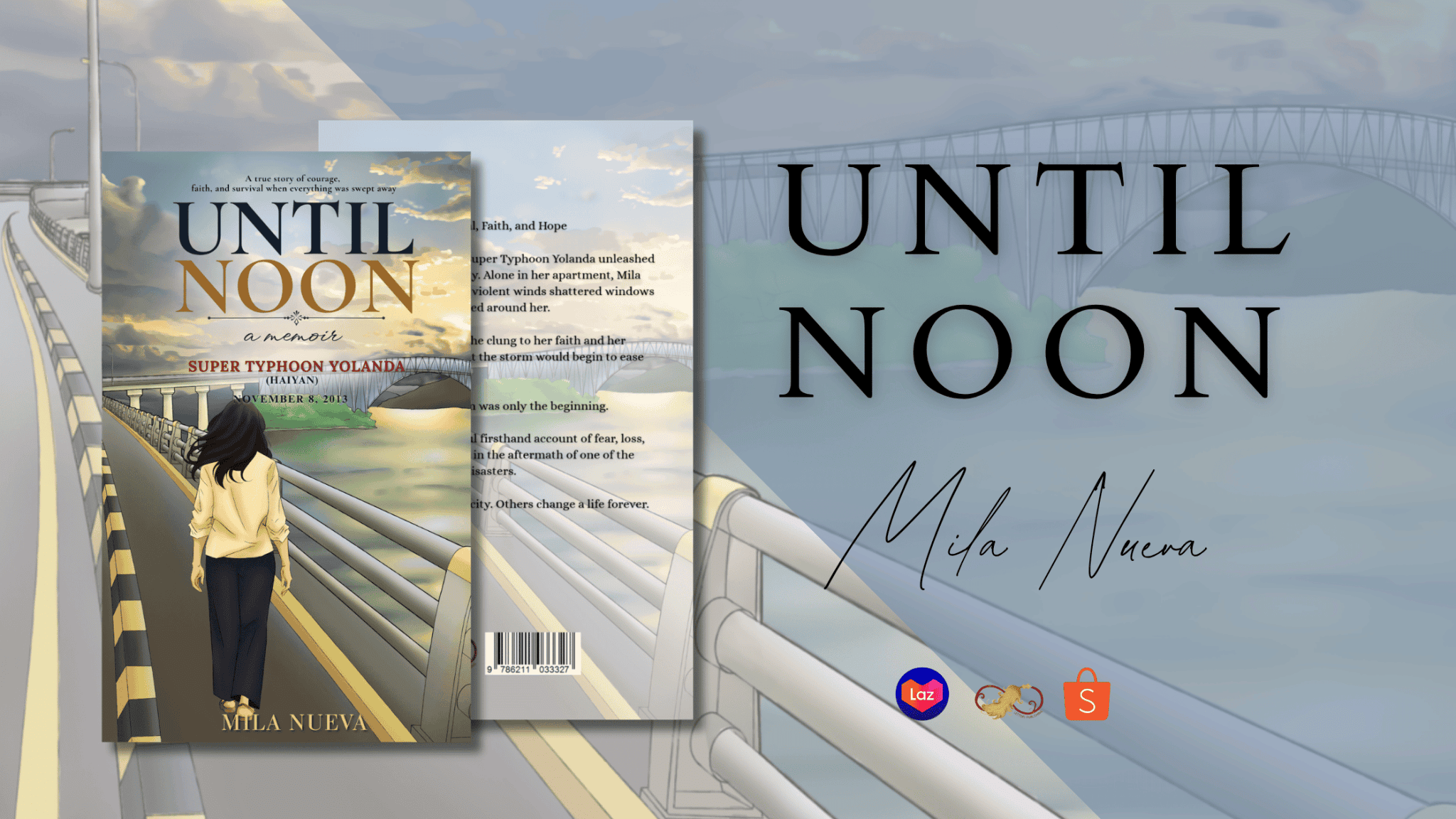
On November 8, 2013, Super Typhoon Yolanda swept through Tacloban City, bringing devastation unlike anything the world had seen. Alone in her apartment, Mila faced the terrifying storm with nothing but her faith and her grandfather’s quiet words, that the storm would ease by noon. What followed was a day of fear, loss, and an unbreakable spirit that refused to give up.
Until Noon by Mila Nueva is more than a story about typhoon. It is a deeply personal account of what is means to lose everything, yet find the strength to keep going. It is about holding onto hope when all seems lost, and the courage that survives long after the winds have died down.
Let’s talk more the story behind the book:
What inspired you to write Until Noon, and why did you feel this story needed to be told?
For many years, the memories of Typhoon Yolanda remained with me. I could still remember the sounds, the fear, the uncertainty, and the overwhelming destruction that followed. Although life moved forward, those memories never faded.
I wrote Until Noon not because my experience was more extraordinary than anyone else’s, but because it was one of the countless stories of survival that deserved to be remembered. I wanted to preserve what I witnessed and felt, including the ordinary moments that became extraordinary in the face of disaster.
What does the title Until Noon represent for you personally?
The title comes from something my grandfather used to say – even the typhoon respects twelve o’clock.
During Yolanda, as the wind grew stronger and destruction unfolded around me, I held on to that belief. Noon became more than a time on the clock. It became something to wait for, something to believe in when everything around me seemed uncertain.
Personally, Until Noon represents hope in the middle of fear. It means holding on, minute by minute, until the worst has passed.
When you look back at that day, what is the one memory that stays with you most?
One memory that remains especially vivid is being alone inside my apartment while the windows swung violently, glass shattered, and the wind seemed determined to tear everything apart.
I remember trying to secure the windows with belts, watching water seep inside, hearing trees snap, and praying while waiting for noon.
What stays with me is not only the frightening force of the typhoon but also the feeling of hopelessness-knowing that, despite I tried to do, there was very little I could control.
That feeling stayed with me long after the storm ended.
How do you define “survival” now, compared to how you saw it before the storm?
Before Yolanda, I thought survival simply meant staying alive through a dangerous situation.
After Yolanda, I realized that survival is much more than that. It is living with memories that do not easily disappear, finding the courage to continue after witnessing devastation, and learning to appreciate things we once took for granted.
Survival is not always a dramatic act of bravery. It is simply getting through another day, rebuilding what was lost, and finding reasons to hope again.
For many survivors, Typhoon Yolanda isn’t just history, it’s a wound that still opens sometimes. What do you hope this book offers them?
I hope Until Noon offers survivors a sense of recognition and understanding.
Each of us experienced Yolanda differently. Some lost their properties, some lost loved ones, and many carried memories that remain painful even after many years.
I do not claim that my story represents everyone’s experience. It is simply one voice among thousands.
If another survivor reads my book and feels that someone understands even a small part of what they went through, then sharing my story will have been worthwhile.
I also hope it reminds us that remembering is not the same as refusing to move forward. Sometimes remembering is a way of honoring what we have lived through.
Beyond the statistics and the headlines, what do you wish people truly understood about what survivors went through?
Stats can tell us how many people died, how many homes were destroyed, and how much damage a disaster caused. But numbers cannot fully describe what it feels like to be there.
They cannot capture the terror of hearing glass break around you, the uncertainty of not knowing whether your family is safe, or the heartbreak of seeing bodies and destruction along familiar streets.
After Yolanda even the simplest things like food, drinking water, shelter, and news of loved ones, became deeply important.
I want people to understand that behind the statistic is a human story. Every person affected had a family, a home, a routine, and dreams for the future.
What role did faith, family, or community play in your journey, both during the storm and in the years after?
Faith is one of the things I held on to during the storm. Alone in my apartment, frightened, and uncertain of what would happen next, I prayed. Praying gave me something to hold on to when I felt powerless.
After the storm, family became even more important. The uncertainty of not knowing whether my loved ones had survived was one of the most difficult parts of that experience. Finding my way to my sister and the kids and knowing that they were safe brought tremendous relief.
I also witnessed how people tried to help one another despite their own losses and difficulties.
Yolanda reminded me that while disasters can destroy homes and possessions, the bonds of family, faith, and human compassion can help us find the strength to begin again.
What is one thing you want readers to remember long after they’ve finished the last page?
I want readers to remember that behind every disaster is a story that deserves to be heard.
Until Noon is my personal account of fear, uncertainty, faith, and survival. But beyond my experience, it is also a reminder of the countless lives forever changed by Typhoon Yolanda.
We cannot undo what happened, but we can remember, learn, and continue to care for one another.
Above all, I hope readers remember that even in our most frightening moments, there is still a reason to hold on to hope.