

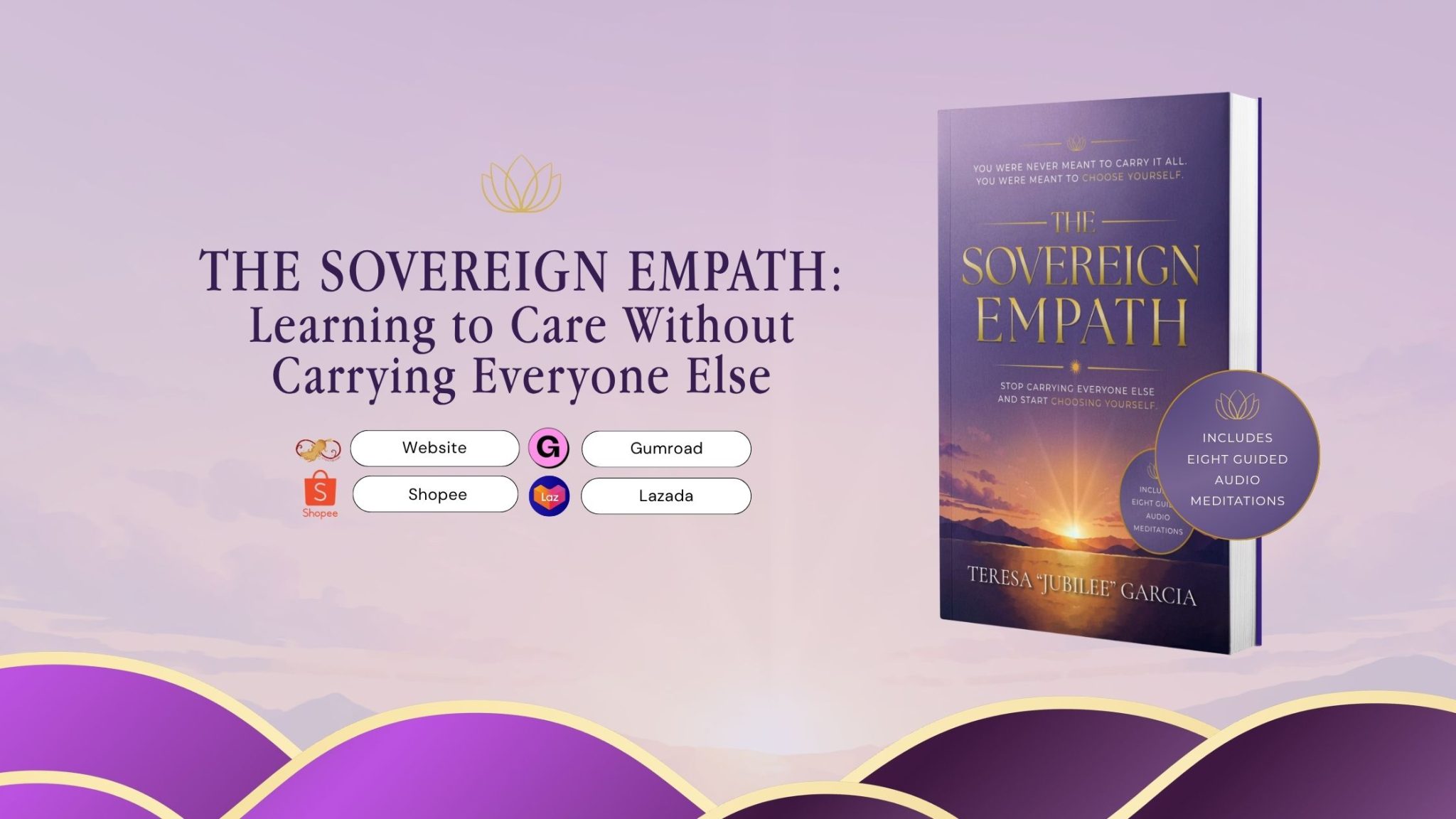
The Sovereign Empath: Learning to Care Without Carrying Everyone Else
For The Sovereign Empath, the journey does not end with the words on the page. Behind its message of compassion, boundaries, self-trust, and personal sovereignty is a deeply personal writing journey—one shaped by experiences, difficult reflections, and the courage to examine what it means to care for others without losing oneself.
To better understand the heart behind the book, we invited the author to reflect on the experiences that inspired its creation, the challenges that came with putting those experiences into words, and the lessons that emerged along the way. Through the following reflections, readers are given a closer look at not only how The Sovereign Empath came to be, but also the intention behind its message and the hope the author holds for those who encounter its pages.
Beyond the Pages: What Does the Book Invite Us to Understand About Ourselves?
The Sovereign Empath: Stop Carrying Everyone Else and Start Choosing Yourself is a personal-growth book for empaths, caregivers, healers, overgivers, and anyone who has spent so much of their life taking care of other people that they have slowly lost touch with themselves.
At its heart, the book is about learning that compassion does not require self-abandonment. You can love people without carrying their emotions. You can help without rescuing. You can care without constantly sacrificing your peace, health, time, energy, and needs.
The book combines personal stories, reflections, practical exercises, journal prompts, and eight guided audio meditations accessed through QR codes. It is designed not simply to be read, but to be experienced as a journey from emotional overload and entanglement toward stronger boundaries, self-trust, and personal sovereignty.
The central message is simple:
You can care without carrying, and you are allowed to choose yourself.
The Need to Say It: What Inspired This Book to Come Into Being?
I wrote this book because I realized that many of the struggles I had experienced throughout my life shared the same underlying pattern: I had become very good at being there for other people, but I had not always been equally present for myself.
For years, I believed that being loving meant giving more, understanding more, tolerating more, helping more, and sometimes carrying burdens that were never mine to carry in the first place.
Through my own healing journey and through years of working with people as an energy healer, I began recognizing how common this pattern is. Many deeply caring people are exhausted not because they do not know how to love, but because they have never been taught how to love without abandoning themselves.
I wanted to create the book I wish I had encountered earlier in my own life—a book that could gently remind people that boundaries are not the opposite of love. Sometimes boundaries are what allow love to remain healthy.
When Life Becomes a Calling: What Experiences Shaped the Heart of the Book?
Yes. The book is deeply connected to my own experiences.
One of the biggest turning points came when my life changed dramatically and I found myself dealing with stress, anxiety, major transitions, family dynamics, relationship issues, and the consequences of decisions I had made while trying to accommodate other people’s needs and expectations.
I began questioning how much of my life had been shaped by what other people wanted from me and how often I had postponed my own peace because I felt responsible for everyone else.
That realization was uncomfortable.
I had spent years helping other people heal, yet I also had to confront the places where I was still overgiving, overfunctioning, absorbing other people’s emotions, feeling guilty for saying no, and looking outside myself for permission to choose what was right for me.
Writing The Sovereign Empath became part of my own process of understanding those patterns.
In many ways, I was not writing from a mountaintop after everything had already been resolved. I was writing while I was still learning how to become more sovereign myself.
Writing Through What Hurts: What Made It Possible to Keep Going?
I kept writing because I knew the book was bigger than the memories that were being triggered.
There were moments when writing brought me back to experiences I would have preferred not to revisit. But every time something surfaced, I asked myself what wisdom could be taken from it.
Instead of allowing the difficult experiences to become the end of the story, I wanted to transform them into something that could help someone else recognize a pattern in their own life sooner than I did.
I also kept thinking about the person who is exhausted from being everybody’s strong one—the person who gives, fixes, rescues, accommodates, and carries so much that they no longer know where everyone else ends and they begin.
If even one reader could recognize themselves in these pages and finally say, “I don’t have to keep living this way,” then the vulnerability required to write the book would have been worthwhile.
And somewhere along the process, I realized that I was not only writing the book.
The book was also changing me.
The Weight of Telling the Truth: What Challenges Emerged Along the Way?
The greatest challenge was emotional.
Writing honestly meant looking at my own patterns without hiding from them. I had to revisit relationships, decisions, disappointments, grief, family dynamics, and moments when I had given away far too much of myself.
Sometimes I would write something and suddenly understand an experience in a completely different way.
There was also the challenge of deciding how much of my personal life to reveal. A memoir-based self-help book requires vulnerability, but I also wanted the focus to remain on what the reader could learn from those experiences rather than simply recounting what happened to me.
Another challenge was translating something as intangible as emotional and energetic boundaries into practical tools people could actually use.
That is one reason I included guided meditations, reflection questions, journal prompts, exercises, and the seven-day reset process. I wanted the book to move beyond information and give readers an opportunity to practice what they were learning.
Making Space for the Work: What Practices Helped Bring the Book to Completion?
I approached the writing process much the same way I approach healing: one layer at a time.
I wrote, reflected, paused when necessary, revisited memories, and allowed insights to emerge rather than forcing everything at once.
Meditation, prayer, journaling, energy work, self-reflection, and simply giving myself quiet time were important throughout the process. When difficult emotions surfaced, I tried not to treat them as interruptions to the writing. Often, they were showing me exactly what needed to be explored more deeply.
I also kept returning to one question:
“How can what I learned from this experience help the person who will eventually read this book?”
That question kept the writing from becoming only about my personal story. It helped me turn lived experiences into lessons, practices, questions, and tools that readers could apply to their own lives.
An Invitation to Choose Yourself: What Does the Author Hope Readers Will Carry Forward?
More than anything, I hope readers give themselves permission to stop abandoning themselves in order to keep everyone else comfortable.
I want them to understand that being an empath does not mean becoming an emotional sponge. Being compassionate does not mean accepting mistreatment. Being generous does not mean giving until you are depleted. And loving someone does not require surrendering your own identity, peace, boundaries, health, dreams, or choices.
For many readers, caring for others and making sacrifices may be deeply connected to their faith, family values, or sense of love and responsibility. I do not want them to see those qualities as weaknesses or to believe they must stop being generous, kind, or devoted. Instead, I hope they begin to recognize that caring for themselves is also an expression of wisdom, stewardship, dignity, and love.
Self-abandonment is not always obvious. Sometimes it looks like being the dependable one, the strong one, the forgiving one, or the person everyone can count on. It can feel noble, loving, and even spiritually meaningful, especially when sacrifice has been praised for so long. But choosing yourself does not dishonor your faith or diminish your love for others. It allows your care to come from freedom rather than fear, guilt, obligation, or depletion.
I hope readers begin asking themselves questions such as:
- Is this actually mine to carry?
- Am I helping, or am I rescuing?
- Am I choosing this freely, or am I doing it because I am afraid of guilt, rejection, conflict, or disappointing someone?
- Can I care for this person without abandoning my own needs, values, and well-being?
And perhaps the most important question:
“What would I choose if I finally included myself among the people I am responsible for caring for?”
Ultimately, I hope readers finish the book feeling lighter, clearer, and more empowered to live their own lives. I hope they understand that choosing themselves is not selfishness, rejection, or a failure to love. It is a way of honoring the life, gifts, body, spirit, and calling they have been entrusted with.
My hope is that they leave with this understanding: you do not have to become less caring to become more whole. You can remain compassionate, generous, faithful, and loving while also protecting your peace, honoring your limits, and making room for your own needs. Choosing yourself is not abandoning the people you love. It is refusing to abandon the person you are.
You don’t have to stop caring. You simply have to stop carrying what was never yours.
Taking the First Step: Where Can Readers Find the Book and Begin Their Journey?
The Sovereign Empath: Stop Carrying Everyone Else and Start Choosing Yourself is available digitally worldwide through Amazon Kindle.
- Readers may also visit: https://www.instantmiracleactivation.com/thesovereignempath for information about the book and its accompanying reader bonuses.
- Physical copies are also available in the Philippines through selected online and direct-order channels, including Shopee and Lazada, subject to availability.
The Philippine paperback edition is priced at ₱899 and includes access to the 7-Day Energy Detox Reset Program, with guided practices and meditations designed to help readers release emotional weight, reclaim their energy, and strengthen their boundaries.


