

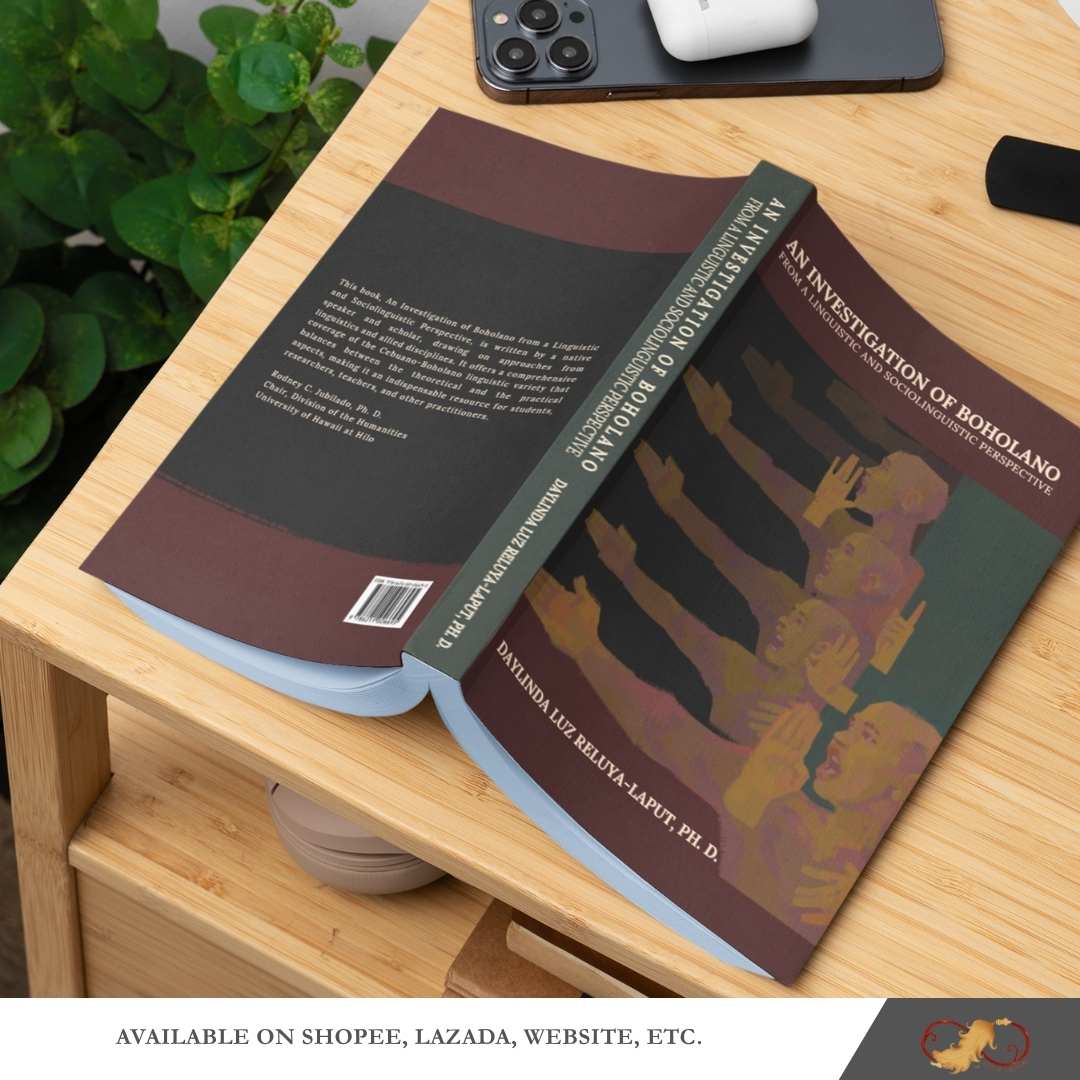
MORE THAN A DIALECT: Dr. Reluya-Laput’s An Investigation of Boholano from a Linguistic and Sociolinguistic Perspective
Language is a reflection of its people; it’s an identity— spoken and expressed. Despite the Philippines being home to more than 180 languages and dialects, many remained uninvestigated, posing a crucial risk of their disappearance. This issue is what Dr. Reluya-Laput is addressing in her book, “An Investigation of Boholano from a Linguistic and Sociolinguistic Perspective”.

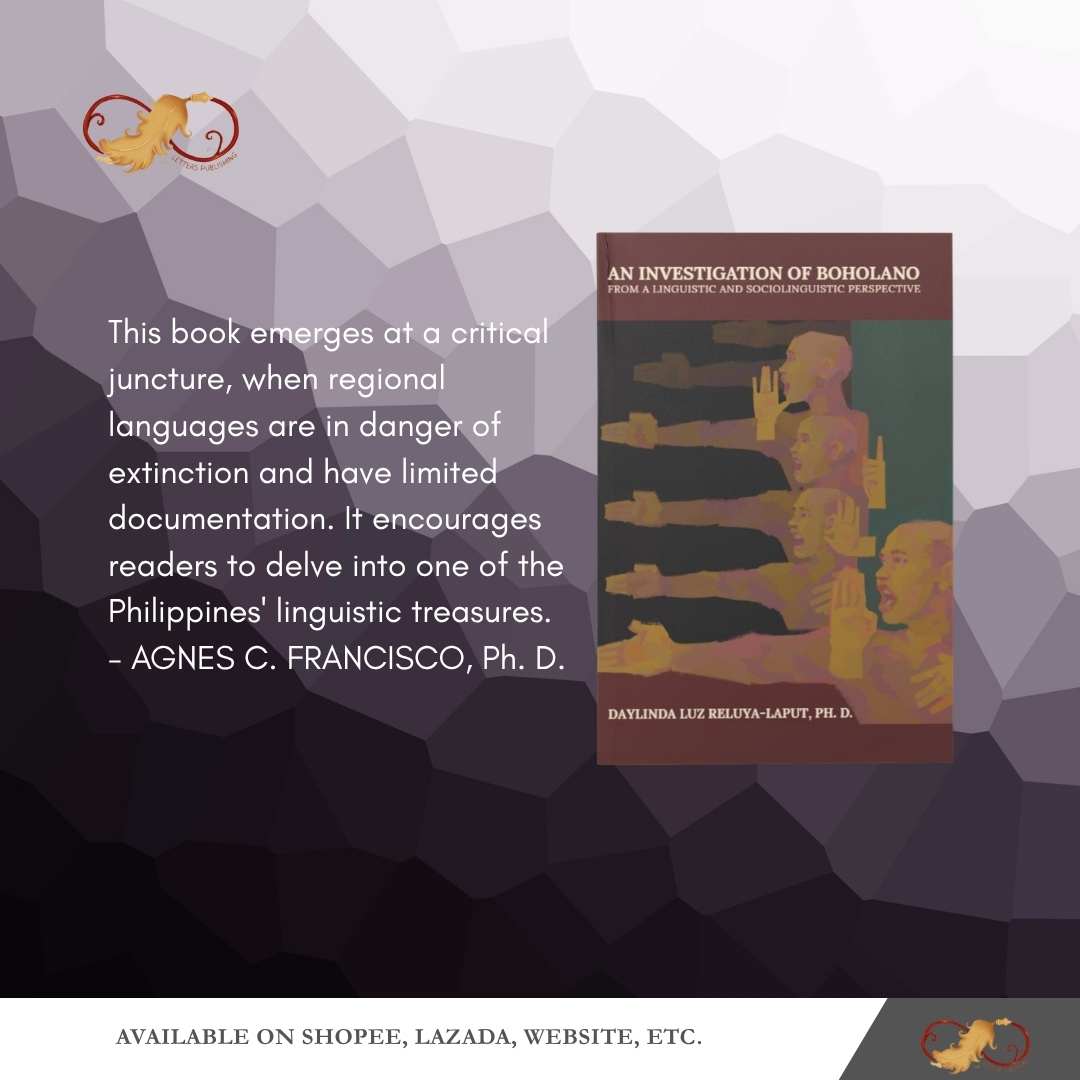
From the perspective of a native speaker and a scholar, Dr. Reluya-Laput draws on a multidisciplinary approach anchored in linguistics. This study provides a comprehensive coverage of Cebuano-Boholano, showcasing how language shapes identity while reflecting the author’s personal view that Boholano is more than a dialect.
THE SCHOLAR BEHIND THE STUDY
Yet, before these broader themes of language and identity, the need to document and investigate Boholano can be traced back to Dr. Daylinda’s academic background. She was an English teacher with a Master’s in English language, and a Doctorate in Applied Linguistics. This path opened an opportunity for her to pursue an ethnolinguistic study close to her roots — Boholano (a dialect of Cebuano), her own mother tongue.
As a native speaker of Boholano, she emphasizes that the language is not merely a dialect but a piece of a bigger picture. “I grew to love Boholano, which for me is not only a dialect, but the tie that binds us Bol-anons – our struggles and aspirations, our small triumphs and setbacks, our dreams and our growing up as a community.”
Writing this book is concerned with filling a gap in Philippine linguistics, making a personal contribution to its roots, and preserving a significant identity within language.
INVESTIGATING THE BOHOLANO LANGUAGE
In addition to the writer’s personal ties, the book required extensive research and time. Dr. Reluya-Laput started with full anticipation, then moved through exhaustion, to a rewarding conclusion with the book release. This arduous process brought to fruition what she had just envisioned for the language.
While Boholano is a long-recognized dialect of Cebuano, its comparison with other Visayan languages has not been explored. Hence, An Investigation of Boholano From a Linguistic and Sociolinguistic Perspective presents an extensive characterization and comparison, including morphology, syntax, and semantics. It also documents actual expressions of Bol-anons, giving it a practical aspect along with theoretical. Yet it is not only concerned with understanding and comprehension of the language, but also with a the core of Bol-anon’s community. “We Bol-anon people understand that language, in this case the Boholano dialect, is not only a tool for communication, but also a powerful symbol of cultural and social identity. It carries Bohol’s history and its people’s values, beliefs, and shared experiences.”
LANGUAGE, IDENTITY, AND CULTURAL PRESERVATION
An Investigation of Boholano from a Linguistic and Sociolinguistic Perspective documents language but, most importantly, highlights the enduring cultural identity of Boholanons in a rapidly globalizing world. Like many other languages, it contains stories, practices, and traditions deeply rooted in the everyday lives of its people.
Dr. Reluya-Laput’s findings push readers to reflect on how identity can be strengthened by communication, recognition, and preservation. With the processes, the history and storytelling are kept alive for future generations. As she emphasizes, “If the dialect is maintained, these stories remain authentic and meaningful and help connect generations. Boholano upholds cultural identity by carrying the history, values, and everyday life of the Bol-anon people in the way they speak, connect, and express themselves.” In this way, it becomes more than a dialect; it is a vessel of cultural memory.
Discover the dialect that carries stories, traditions, and identity of the Bol-anons: An Investigation of Boholano — because when language endures, so does the soul of its people.